
Reading time: 3 min
Uploaded on: February 9, 2026
Having too much energy doesn't necessarily mean you have ADHD. It's normal to feel overly excited or lively, like when working towards a passion or spending time with your friends.
The difference is that people with ADHD can’t control their energy as well. When they need to focus on a task, they struggle to do so. This lack of control makes ADHD a serious psychiatric condition rather than a quirky quality.
What are the symptoms of hyperactive-impulsive ADHD?
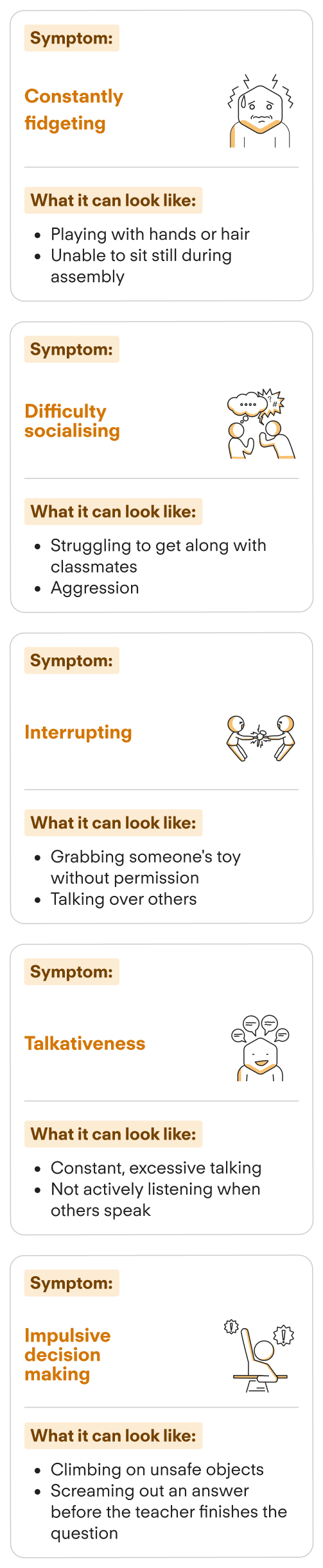
Hyperactive-impulsive ADHD can look different in everyone. Here are a few common symptoms you can look out for:
Common hyperactive-impulsive ADHD symptoms in children:
Common hyperactive-impulsive ADHD symptoms in adults:

What causes hyperactive-impulsive ADHD?
Like all forms of ADHD, the root causes of the hyperactive-impulsive subtype are largely genetic, with environmental factors playing a small role.[1]
While people might assume ADHD is caused by bad parenting or a lack of discipline, this isn’t true. ADHD leads to neurobiological changes that can’t be corrected by yelling or harsh discipline.
Genetic factors
Several genes have been linked to ADHD, including the DAT1, DRD5, DRD2, and COMT genes, all of which are involved in how dopamine is used.[2] Dopamine is sometimes ‘recycled’ too quickly in people with ADHD, resulting in low levels. This can lead to symptoms like difficulty focusing, lack of motivation, and impulsive behaviours.
Other genes associated with ADHD are TPH1 and VIPR2 – a gene mutation in these genes causes low levels of serotonin, which can result in symptoms like anxiety, irritability, and sleep problems.[2]
Environmental factors
Poor diet, stress, and drinking during pregnancy can increase the risk of ADHD. Research has shown that maternal stress can disrupt foetal brain development. This increases the risk of neurobiological disorders, like ADHD.[3]
Maternal smoking and alcohol have also been found to disrupt brain development, especially in the areas that are responsible for attention, memory, and emotional regulation – all functions related to ADHD.[4][5]
While post-birth factors don't necessarily cause ADHD (the genes are present from birth, but can be triggered by your early environment), a poor diet can exacerbate ADHD symptoms. A diet high in sugar and unhealthy fats can negatively impact your brain health, altering the way dopamine and serotonin are used, which makes it harder to focus and pay attention.[6]
Back to:
Read next:
References:
- Faraone, S. V., & Larsson, H. (2019). Genetics of attention deficit hyperactivity disorder. Molecular Psychiatry, 24(4), 562-575.
- Prasad, S., & Kumminimana, R. (2025). Attention-deficit/hyperactivity disorder: Insights, advances and challenges in research and practice. Advances in Psychiatry and Neurology, 34(3), 196.
- Okano, L., et al. (2019). Maternal psychosocial stress and children’s ADHD diagnosis: a prospective birth cohort study. Journal of Psychosomatic Obstetrics & Gynecology, 40(3), 217–225.
- Huang, L., et al. (2017). Maternal Smoking and Attention-Deficit/Hyperactivity Disorder in Offspring: A Meta-analysis. Pediatrics, 141(1), p.e20172465.
- Pagnin, D., Zamboni Grecco, M.L. and Furtado, E.F. (2019). Prenatal alcohol use as a risk for attention-deficit/hyperactivity disorder. European Archives of Psychiatry and Clinical Neuroscience, 269(6), pp.681–687.
- Del-Ponte, B., et al. (2019). Dietary patterns and attention deficit/hyperactivity disorder (ADHD): A systematic review and meta-analysis. Journal of Affective Disorders, 252, 160-173.
Reading time: 3 min
Uploaded on: February 9, 2026