

Reading time: 8 min
Uploaded on: March 20, 2026
The variety of qualities needed to get, keep, and succeed in a job (like time management, attention to detail, and motivation) don’t always come easily for people with ADHD.
In some situations, this can affect a neurodiverse person’s everyday work, long-term performance and progression prospects – and even impact their chances of landing the job they’re applying for in the first place.
To help us understand these impacts better, we recently ran a survey asking people living with ADHD about their experiences at work.
Our main findings were that:
- 82% said they’d either waited a year to tell their employer that they had ADHD, or hadn’t told them at all
- 77% said that ADHD had negatively impacted their performance at work
- 57% said they had ‘failed’ a job interview because of ADHD
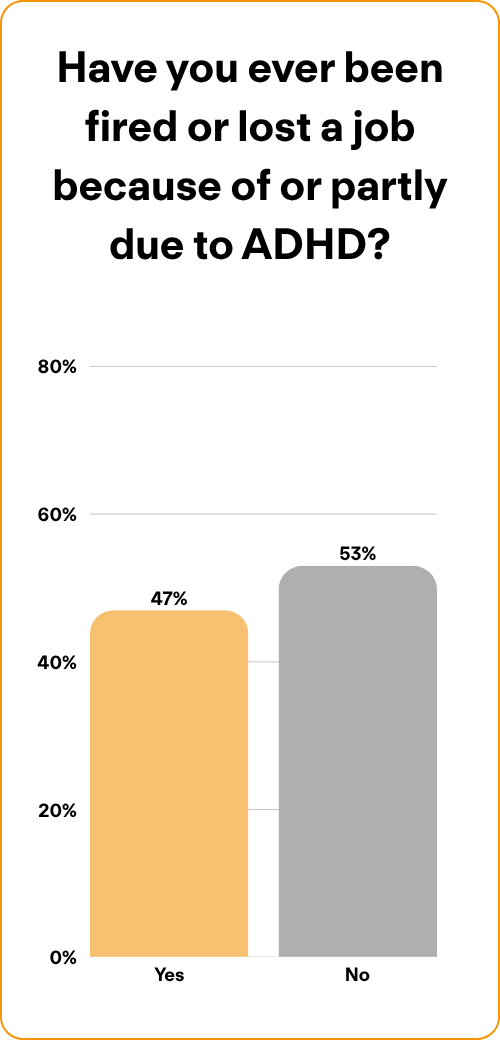
- 47% said they had lost a job due to or partly because of ADHD
- 56% said ADHD had caused them to have disciplinary issues at work
The survey, which ran from late December 2025, was open to adults living with ADHD and collected responses for six weeks. It was promoted in partnership with the ADHD Chatter Podcast, presented by Alex Partridge.
Here are all the details on the findings:
When do people first tell their employer that they have ADHD?
We asked:
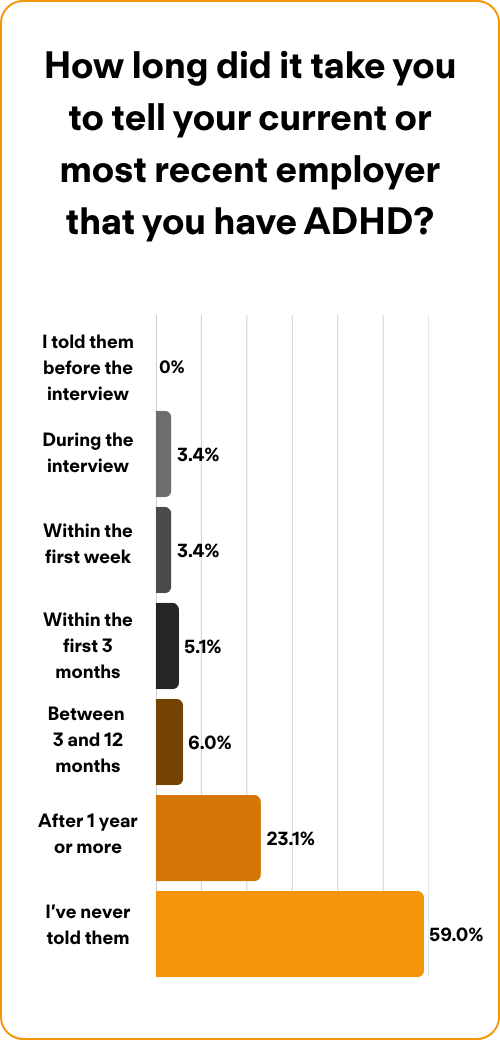
These findings suggest that new employees may often be cagey about revealing their ADHD diagnosis.
With 59% saying they hadn’t told their employer, and a further 23% saying they’d waited at least a year to tell them, this adds up to a combined 82% choosing to wait until a ‘safer time’ to share their diagnosis with their boss. The probation period for most roles is 3-6 months, and in the UK, a new employee gains more rights and protections against unfair dismissal after two years.
This result may be indicative of the stigma surrounding ADHD. A neurodiverse person might be reluctant to share their diagnosis early in their employment for fear it will change the way they’re perceived and foreshadow lower expectations of them.
In the slightly longer-term, someone with ADHD might be apprehensive about how sharing their diagnosis will affect their progression prospects.
Out of the 18% who did tell their employer within the first year, only 12% did so within the first three months of employment.
It’s quite common for employers to ask new employees about any existing health conditions during the first few weeks of their employment, so that they can consider the need for related adjustments.
So this data suggests that the majority of people with ADHD don’t share their diagnosis even when asked – but this could be for other reasons besides fear or stigma.
ADHD may not be viewed by everyone as a ‘health condition’ per se, and feel it may not warrant being declared at this stage.
Others may have been incumbent in their current jobs for several years – and at the time of securing their role, ADHD might not have been as widely-known or discussed as it is now.
Focused Clinical Lead, Danielle Mulligan, noted that:
‘It’s natural to have some anxiety about how we’ll be perceived when we reveal our diagnosis. And it’s common for people to have preconceived notions about ADHD – people with the condition are sometimes viewed as lazy, inattentive or lacking in motivation.
This, in an employee’s mind, might stop them from sharing their diagnosis for fear of not being given more responsibility, and missing out on progression opportunities.
While it’s up to the employee to tell their employer about their diagnosis, it’s probable that many employers could do more to make sharing this info easier, and less riddled with feelings of uncertainty.
By creating a space for understanding, and reassuring a new employee that they won’t be judged by their neurodiversity, it’s likely that the new employee will take to their role with a higher level of confidence and the knowledge that they can be open about their symptoms.
The upside of this for employers is that, if issues arise in future, they can better support the employee to overcome them – which should enhance their overall performance and productivity.’
Do people get fired because of ADHD?
We asked:
and we also asked:
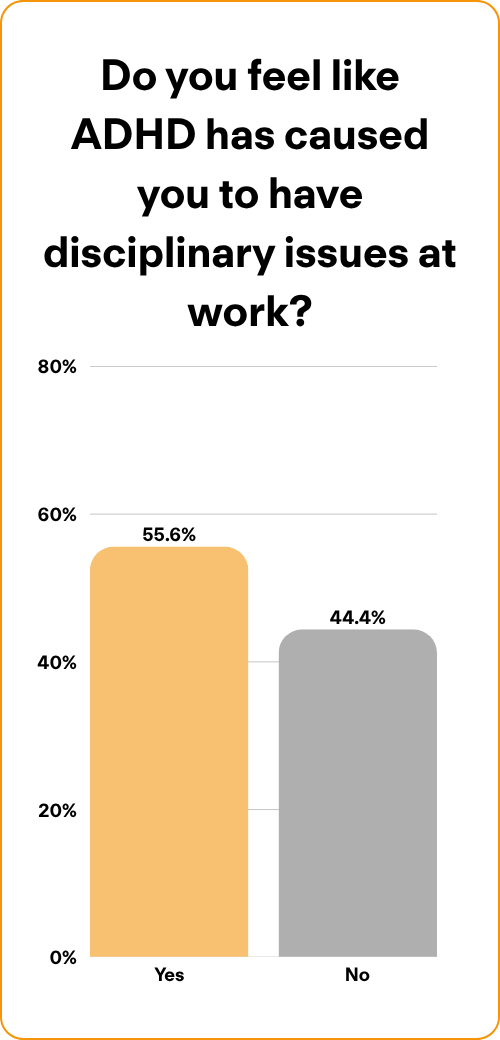
That almost half of respondents said that ADHD has cost them a job, or that it had at least played a role in them being dismissed, demonstrates how tricky it can be to navigate employment with the condition. And this is further supported by the more than half of respondents who said that they’d faced disciplinary issues because of ADHD.
There are a few things we know about ADHD symptoms, and how these might impact someone’s performance at work.
- ADHD can cause someone to have poor organisational and time management skills, which can lead to lateness and missing deadlines with tasks.
- Dopamine dysfunction, which is quite common in ADHD, can lead to a loss of motivation, which may result in someone taking less of a proactive approach to tasks and seeming uninvested.
- Loss of attention, a core trait of inattentive ADHD, might cause someone to be easily distracted in meetings, which may lead to others questioning their commitment to the job or reaching wider organisational goals.
- Inattentiveness may also result in someone seeming to take ‘shortcuts’ or miss details in work, and serve work of a poorer quality, which can also hinder progression prospects and potentially lead to disciplinary issues.
- Hyperactivity may cause someone to talk excessively or appear overly energetic, which could, in some work situations, adversely affect the team dynamic.
- Impulsivity may cause someone to blurt out answers in meetings before it’s their turn to speak, or make potentially rash decisions which affect their performance and that of the company – which again could lead to them not being considered for more senior positions, or cause their suitability for their role to be called into question.
But there are additional factors that could exacerbate the effects on job performance we’ve outlined:
- Many people with ADHD don’t disclose their diagnosis to their employer (see above), and so may not receive the support, understanding and adjustments that may be beneficial in helping them to perform better.
- That said, even in cases where someone has shared their diagnosis, a lack of understanding of ADHD may cause some employers to be less sympathetic or accommodating.
- Late diagnoses are becoming more common, and people who don’t know they have (or didn’t they had) ADHD prior to being subjected to disciplinary action or dismissal would likely not have been able to explain the reasons behind their poor performance.
People with ADHD may struggle with emotional regulation, and disagreements during discussions about poor performance between employee and employer could become more heated, and potentially accelerate dismissal.
Danielle Mulligan commented:
‘These are sad statistics to see, but probably not too surprising for many people with ADHD.
It’s common for symptoms like inattentiveness to make it seem like someone is disengaged in a conversation – which could easily not play well in meetings or in general workplace settings.
It can also mean that someone misses the details in a piece of work, that leads them to be labelled as careless or ‘sloppy’.
People with ADHD also have to deal with the effects of dopamine dysfunction, which might hinder motivation, and make them seem less proactive and impact their work rate.
From a workplace dynamics point of view, hyperactivity and impulsivity might be seen as disruptive factors too. These symptoms can impact on how well someone listens and waits for the right cue to speak during a meeting.
Although what we’ve described may seem like minor issues, over time they can add up and may affect how someone is perceived – particularly if that person hasn’t disclosed their ADHD diagnosis.
There’s also the potential for these symptoms to manifest in a more dramatic way too. Impulsivity and emotional dysregulation could escalate a difference of opinion into a more heated disagreement, that in an extreme case could turn unprofessional. And poor timekeeping might lead to repeated lateness that reaches the point of dismissal.’
How does ADHD affect performance at work?
We asked:
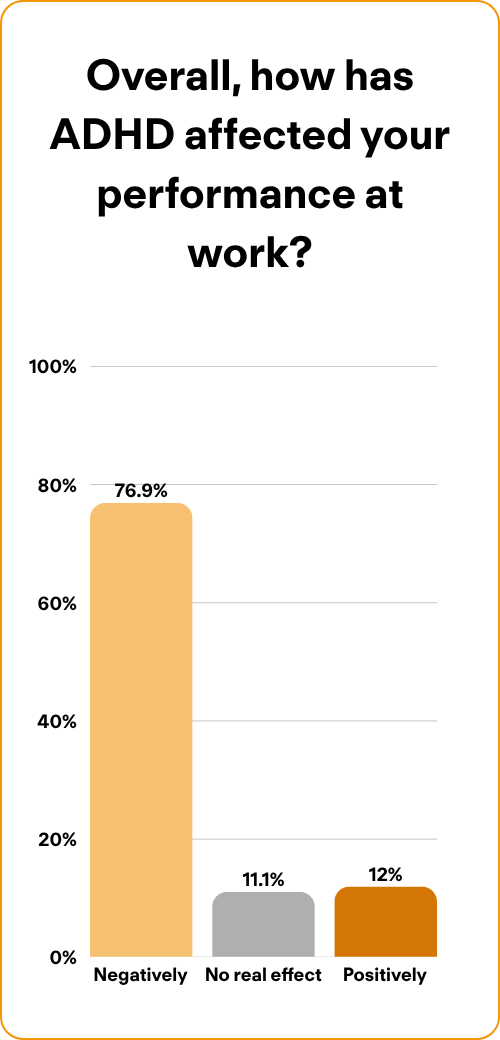
These results suggest that, overall, ADHD has a detrimental effect on workplace performance.
This implies that those symptoms that have the potential to negatively impact workplace performance (such as inattention, poor time management, executive dysfunction, impulsivity) stack up disproportionately against the symptoms that may positively impact performance (such as hyperactivity or hyperfocus), producing an overall ‘net negative impact’.
But there are some encouraging results to take away from this.
11% of respondents said that ADHD has no effect either way on their performance at work, which may suggest good symptom management.
And 12% said that it had positively affected their performance, which may indicate that they’re channeling their symptoms in a way that helps them to be more productive or innovative.
Responding to this, Danielle Mulligan noted that:
‘The phrase ‘ADHD is my superpower’ is one that we’re starting to hear more of now that awareness of the condition is increasing and people are beginning to understand it better. And it’s encouraging to see that around 1 in 8 people here feel as though they can channel these symptoms in a positive way.
Due to their different way of thinking, many people with ADHD take an alternative approach to solving problems, thinking ‘outside of the box’ to overcome obstacles in a task. It’s common for people with ADHD to excel at creative activities too, again due to the way a neurodiverse brain works.
Hyperactivity symptoms can provide someone with the bursts of energy they need to be more productive, or bring enthusiasm into a meeting or group activity. And hyperfocus – which many people with ADHD experience – can mean that someone is able to complete a complex, intensive or fiddly task in a swift and methodical manner.
But as much as these might be beneficial effects, there are several ADHD symptoms with the potential to have a negative effect on someone’s performance at work. Inattention, impulsivity, emotional dysregulation, executive dysfunction and others can all impede someone’s ability to perform well – and judging by this data, these symptoms tend to have more of a profound effect than those which can be beneficial.’
Does ADHD affect job interview performance?
We asked:
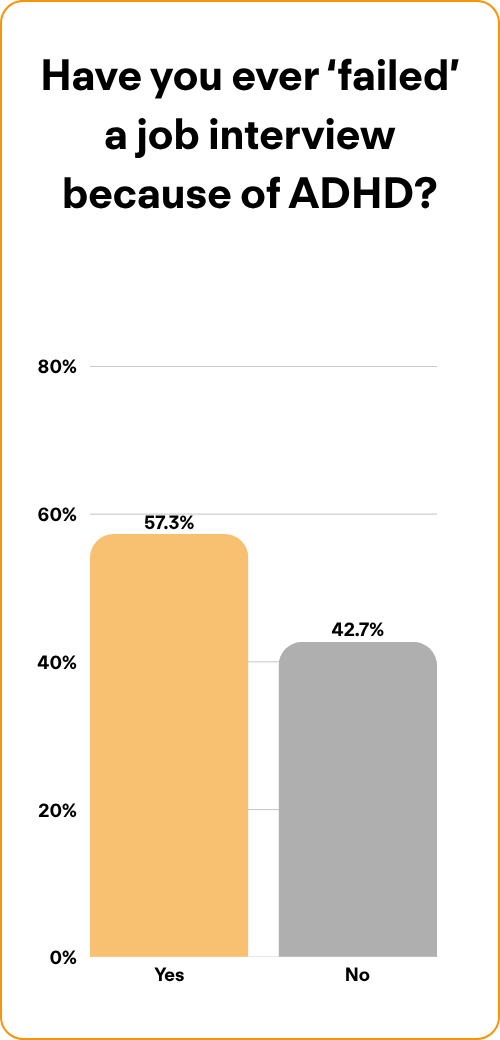
There are several aspects of ADHD that could adversely affect how someone performs in a job interview – and it’s likely we’re seeing that reflected in these results, with over half of respondents saying that ADHD had been the cause of an interview going badly.
For example:
- Inattention might make it seem like a potential candidate doesn’t care much for the role or is disinterested in the conversation
- Impulsivity may cause a candidate to blurt out an unconsidered answer or interrupt the interviewer mid-sentence
- Excessive talking may mean the candidate talks over the interviewer or misses social cues
- Poor organisation and forgetfulness may affect a candidate’s preparation for the interview, so that they aren’t able to answer questions to the standard expected
Many candidates will also go into an interview with the added pressure of their interviewer not knowing about their diagnosis – only 3.4% of respondents said that they disclosed this to their employer at the point of interview.
Danielle Mulligan noted that imposter syndrome and rejection sensitive dysphoria (RSD), which are common in people with ADHD, may be also be prominent factors affecting interview performance too:
‘The symptoms we closely associate with ADHD – like inattentiveness and impulsivity – can have an impact on how well someone comes across in an interview. They might cause someone to seem disinterested, blurt out an answer that isn’t fully considered, or interrupt an interviewer before they’ve finished speaking.
But imposter syndrome is a big thing for people with ADHD too, because they’re more likely to have had to deal with criticism and inconsistent performance in the past, and be hyper-critical of themselves as a result. Forgetfulness might also cause them to focus less on previous achievements and more on the negative experiences that stand out.
And let’s not forget RSD. Anxiety around rejection in someone with ADHD might be so intense, that the prospect of missing out on a job becomes overwhelming in the moment, and nerves take over – which can impact how well they perform in an interview.
One way to deal with the above is to document wins and achievements – not just right before an interview but throughout your working life – so you’ve got a solid reference to go back to when you need it. Every time you make a positive difference, write it down – then you’ve got an example to cite when asked for it.’
Reading time: 8 min
Uploaded on: March 20, 2026