

Medically reviewed by Danielle Mulligan Clinical Lead
Reading time: 10 min
Uploaded on: October 13, 2026
For many young people, attending further and higher education is their first experience of ‘practical adulthood’. The support structures they had at home and school often don’t follow them to college or university, and this is where – for many – ADHD can first become apparent.
From October to September, 2026, we ran a survey asking people with ADHD how they felt the condition affected their studies and social life during this time. The survey was open to people aged 18 or over, and 335 people responded. They findings were that:
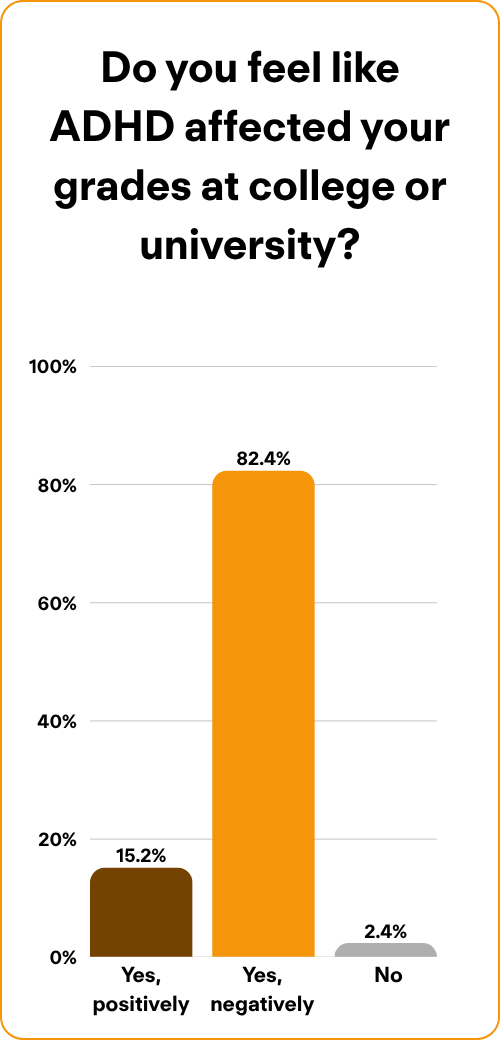
- 82% said ADHD had negatively impacted their grades at college or university
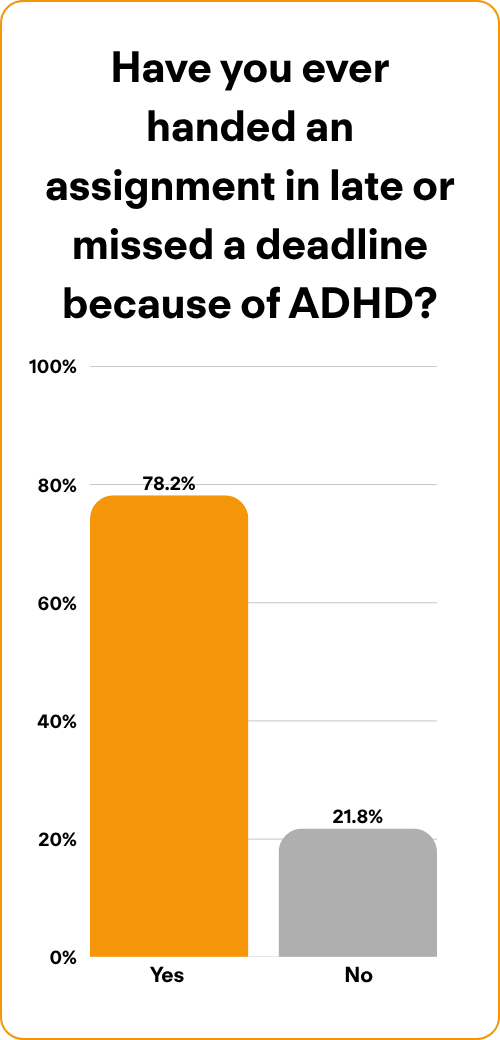
- 78% said they’d handed in an assignment late because of ADHD
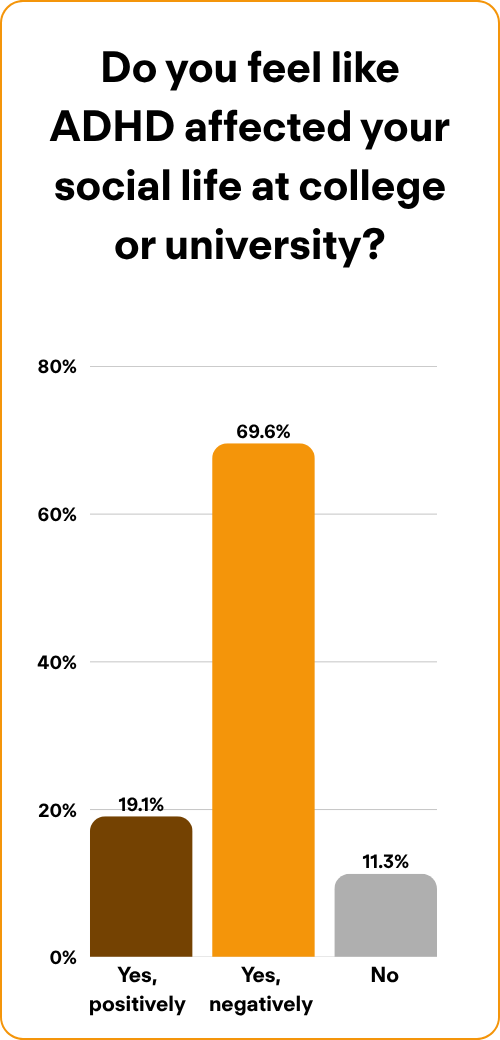
- 70% said the condition had negatively impacted their social life at college or university
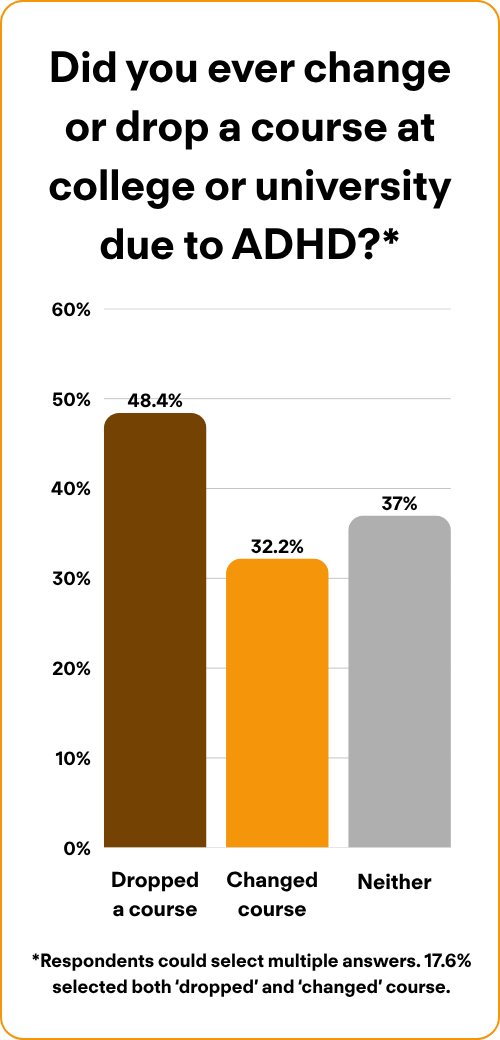
- 48% said they’d dropped a course due to ADHD
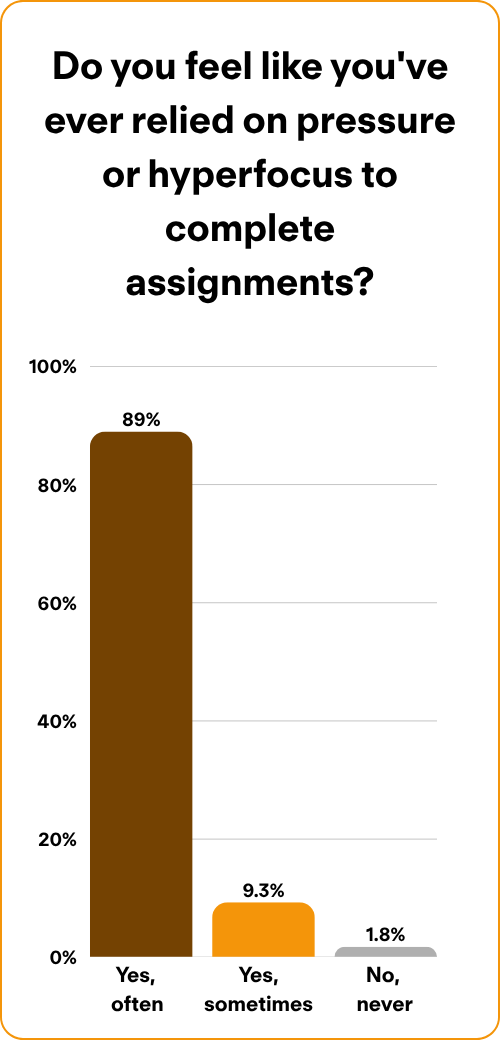
- 98% said they’d relied on hyperfocus to complete assignments
On this page we’ll take a closer look at the results, and get expert analysis from Focused Clinical Lead Danielle Mulligan.
How does ADHD impact academic performance?
The results indicated that, overall, ADHD had a perceived negative effect on college and university grades.
There might be several reasons for this, as Danielle explains:
‘Firstly, there’s the direct impact of ADHD symptoms on completion of work. Inattention can make it harder to take in and retain information during lectures, and stay trained on an assignment. Restlessness may make it more difficult to stay seated at a desk and get down to work on an assignment. And time-blindness can cause us to underestimate how long it might take to complete a piece of work, and hand it in late as a result.
But there are the secondary effects to consider too, such as a change in support network.
Young people with ADHD may have had quite comprehensive support to get them through earlier academic years from their parents when living at home, and from teachers having a closer oversight of tasks at school.
But when a young person moves out of the home to go to university, and undertake a course that involves few contact hours and mostly independent research, the scaffolding they had before is suddenly removed.
For some students, this might be the first time that ADHD symptoms have become apparent to them – and when these struggles are so new, it can take time to learn the required coping strategies, access support, and get the right adjustments in place. In the meantime, this may mean that grades can be adversely affected. A student who did well all the way through school might get to college or university, suddenly see they’re underperforming, and not know why.’
Only a very small percentage of respondents – 2.4% – said that ADHD had no effect, while a sizeable minority of 15.2% felt ADHD worked in their favour.
‘The other side of this is when students can anticipate their own behaviours and take measures to prevent ADHD negatively impacting their work.’ Danielle explains.
‘A young person might be already aware of their ADHD because they were diagnosed while they were at school, or they might not have a formal diagnosis yet but know the struggles they’ll face when the time comes to complete an assignment. They might purposefully go around their study environment and remove distracting stimuli, put their phone somewhere they can’t see it, or set aside hyperfocus time to get things done.
So while for some people ADHD can be disruptive, for others it might be a motivating factor to keep a stricter, more disciplined mindset.’
How does ADHD impact meeting course deadlines?
The majority of respondents (78.2%) said that ADHD had caused them to miss a deadline or hand in an assignment late.
Time-blindness, task paralysis and executive dysfunction are all prominent struggles that can hinder someone with ADHD when working on something time-sensitive.
But less obvious factors associated with ADHD like hyperfocus and dopamine deficit might impact this too.
‘Hyperfocus can work in your favour when trying to get an assignment done, but it can work against you too.' Danielle explains.
'For example, becoming engrossed in a side-quest and losing track of time sunk into it – which is easy to do with ADHD – can result in not setting enough time aside to work an important assignment, and potentially missing the deadline.
The ADHD brain may also have a higher threshold for motivation than a neurotypical brain, and need more urgency to take action. A closer, looming deadline can often function as this added element of urgency – but again, this motivation to get the assignment done might not kick in fully until it’s too late, and there’s too much work to do in too short a space of time.
The way dopamine works in ADHD brains can sometimes be a factor too. Dopamine levels tend to be lower in people with ADHD, which means that they may often seek out quick mood-boosting behaviours to achieve a ‘dopamine hit’.
Shorter side-quests – putting the washing away, meal prepping for the next couple of days, ordering new stationery – are productive tasks that might give someone a quick dopamine boost and at the same time feel like responsible things to get done.
Completing an assignment on the other hand is often a long, complex process that has to be done in stages – and the dopamine payoff (handing the assignment in or getting a good grade back) can seem much further away. So the ADHD brain won’t always get itself around a longer task like this as easily.’
How does ADHD impact social lives at university?
Over two thirds (69.6%) of respondents said that ADHD adversely affected their social lives during college or university.
Making friends in a new setting – at what can feel like a particularly complicated time of life – can be challenging in any case. But with the added internal struggles that ADHD sometimes brings, establishing and maintaining social relationships can seem even tougher.
‘Some people with ADHD get what’s called ‘auditory fatigue’ and ‘auditory processing difficulties’.' notes Danielle.
'These are problems where someone is in a conversation with someone else and listening to them, but their brain has to work harder to filter out external stimuli around them – noises, movements, and so on – and this makes it harder to latch on to and process the information that’s coming to them in the conversation.
This is one of the reasons why people with ADHD might seem like they’re not listening when being spoken to. A lot of the time, their brain is actually working really hard to listen – but working too hard and can’t get past itself.
Working memory can affect this too. By the time someone has processed the first part of a sentence, they may have lost the thread during the second part – and the meaning is then lost. In a social setting, it can feel really awkward to then go back and say to someone you’ve just met: ‘Excuse me, please can you repeat that last part?’ so it’s easier to just carry on like you’ve heard it and registered everything.
Social anxiety is also much more common in people with ADHD, because they’ve often had to deal with lots of criticism when growing up, or they’ve had experiences where impulsive behaviours had made interactions feel awkward, or they’re worried about misreading social cues. All of this can make it harder to approach people and establish friendships in the first place.
Masking, a coping strategy which many people with ADHD develop, can also be mentally draining. This is where someone with ADHD works hard to compensate for symptoms and appear more neurotypical – for example rehearsing replies internally, or mirroring mannerisms or behaviours of the person they’re speaking to – and it can often be a subconscious reflex.
And then there’s the practical difficulties that sometimes come with ADHD to consider too, which really come into play when trying to maintain friendships – being late to meet a friend due to time blindness for example, or not replying to texts because of task paralysis.’
But in the context of developing friendships, ADHD might sometimes be indirectly beneficial too. Interestingly, there was a sizeable minority of respondents (19.1%) who said that ADHD had a positive effect on their social lives during their time in education.
‘It’s nice to see a minority of respondents who said that ADHD had a positive effect on their social lives.’ notes Danielle.
‘For some people, symptoms might work in their favour. Impulsivity may spur them on to talk to someone new and establish a friendship. Hyperactivity can sometimes make someone appear more socially outgoing too – they might be more talkative or engaged in a conversation, and these are traits that people might feel more drawn to.
On a deeper level, people with ADHD can often be less judgmental than their neurotypical peers, and seem more approachable and understanding of people’s differences – making for a more substantive lasting friendship.’
Do students drop out because of ADHD?
Dropping a course during study is a big decision, and often an acknowledgement that a course doesn’t feel right. The structure of learning, subject matter and assessment criteria may not always complement someone’s particular strengths – and while some people living with ADHD may adapt well to certain courses, the results of the survey suggest that it can be an obstacle to completion too.
- Nearly half of respondents (48.4%) said they’d dropped a course due to ADHD.
- Just under a third (32.2%) said they’d changed course due to ADHD.
- Respondents were also able to select more than one answer to this question: 17.6% said that they had dropped a course and changed course at some point due to ADHD.
As Danielle explains, there are several reasons why someone with ADHD may be more likely to decide a course isn’t right for them.
‘The big one is novelty. ADHD brains seek it out, and again this comes back to dopamine. For some courses, the subjects being covered may seem interesting on the surface, but the depth the course goes into when exploring a topic might come to feel laborious or repetitive – and for someone looking to be continually engaged by something new and exciting, this slower and more methodical level of research may not engage them as well.
Removal of support structures and time-management are obviously practical factors too. Someone may feel like they can’t complete a course because they can’t adapt to the workload. For example, there might seem like too many facets to manage – reading, research, bringing and presenting materials in seminars, as well as assignments and exam revision – leading to overwhelm.
RSD (rejection sensitivity dysphoria), which is common in people with ADHD, might mean someone takes a lower-than-expected module grade or negative feedback a little more to heart. This can affect their confidence and lead them to question their ability to complete the course.
And then, before all of this, there’s the actual course selection itself that could be a factor too. Time-blindness might mean someone doesn’t make a decision on the course they’re choosing until the deadline is looming – and so they make a snap decision without really taking time to see what the course involves.’
An important consideration here is that the survey was open to people living with ADHD aged 18 or over – some of which may have attended university or college several years or even decades ago. Over time, as awareness of ADHD has grown, better support structures for people in full-time study have been developed – so this number may not be reflective of the number of people with ADHD dropping or changing a course currently.
Can hyperfocus help with university work?
An overwhelming majority of respondents (98%) said they’d relied on hyperfocus to complete an assignment – 89% ‘often’, and 9% ‘occasionally’.
Hyperfocus is a state where someone becomes so engrossed in a task or activity, that they may lose track of time or find it difficult to bring their attention away from what they’re doing. Because the task at hand becomes the sole focus of their attention, they might even disregard basic needs like eating, drinking and sleeping – and so skip meals or go to bed at an unusually late time.
People with ADHD are more prone to periods of hyperfocus, and again dopamine plays a role, as Danielle explains:
‘When a task provokes a heightened sense of interest or urgency – for example because the deadline is first thing in the morning – this creates a strong dopamine response in the brain. This means that completing the task becomes everything, and it’s difficult to consider anything else.
As the results suggest, this hyperfocus might be advantageous and even come to be something someone knows they’ve got in the locker as the deadline looms closer and the pressure dials up.
And because it’s an internal chemical reaction, some people might feel like they have no choice but to let it lead their study pattern. For example, they might even sit down to try and work on the assignment with weeks to go before the deadline, but not be able to find the motivation to get anything meaningful done – and then defer the task until the deadline is closer and the ‘current’ of urgency sweeps them through.
While it sounds like a good failsafe in principle, the problem with it is that it can almost become a ‘learned’ practice over time. If someone is repeatedly condensing workload into very short periods before deadlines, this can lead to more stress and eventually burnout.
And it might not always be beneficial to the quality of the work too – while hyperfocus may ensure an assignment is completed and handed in on time, work in this ‘state’ may have been done during periods of hunger or sleep deprivation, which could have a detrimental impact on how well-executed it is.
So it’s important to remember that hyperfocus is a really individual thing – for some people, it might feel like a reliable safety net during the weeks leading up to an assignment deadline where progress feels slow. But for others, it might actually be a false sense of security, because when the time comes and hyperfocus kicks in, it isn’t actually enough to get the assignment done to the best of their abilities.’
How to make life at college and university easier if you have ADHD
As we’ve explored here, while ADHD can throw up challenges, there are steps someone can take to make the transition to a new learning and social environment easier.
‘Probably the most important one is to let your tutor or course leader know if you’ve had a diagnosis previously.’ Danielle explains.
‘This means they can take any accommodations or adjustments required into account, before you get deep into the work and the pressure mounts up. This might be advice on the facilities available – such as quieter study halls to reduce sensory distraction, or extended book-loans from the library if you’re struggling to get through the materials on time – or even breaking down the course materials into smaller, more manageable chunks with pre-emptive staggered deadlines.’
If you’re living in halls of residence or shared accommodation, letting your housemates know can be beneficial in some cases too.
‘This might seem daunting, but it’s good to remember that ADHD doesn’t have the stigma that it used to, and many people now – particularly younger adults – are more understanding of it.
Making your friends and housemates aware helps to set expectations – for example if a chore doesn’t get done by the time you said it would be, or if you’re late for a social meet-up, people are more likely to be understanding if they know that organisation and time management are things you struggle with.’
And lastly, before making the decision to change or drop a course, talking concerns through with a member of university staff can help to bring perspective as well.
‘Many people with ADHD are their own harshest critics – and this is often a learned behaviour due to having been repeatedly told off or criticised during childhood. So before making a drastic decision to drop a course or module, talk to your tutor or course leader about the things you’re struggling with, and get feedback. You might actually be doing better than you think you are, and positive feedback when you aren’t expecting it can be a big motivator to plough on and make it to the finish line.’
Reading time: 10 min
Uploaded on: October 13, 2026
Medically reviewed by Danielle Mulligan Clinical Lead Registered with GMC (15A0206E) October 13, 2026 Meet Danielle Mulligan