

Medically reviewed by Daniel Atkinson GP Clinical Lead
Reading time: 8 min
Uploaded on: September 16, 2026
Food shouldn’t be thought of as a treatment for ADHD.
But certain foods may help to manage symptoms by:
- keeping energy levels consistent
- supporting brain function
- balancing your gut bacteria
- reducing your risk of inflammation
How you eat (as well as what you eat) can make a difference too.
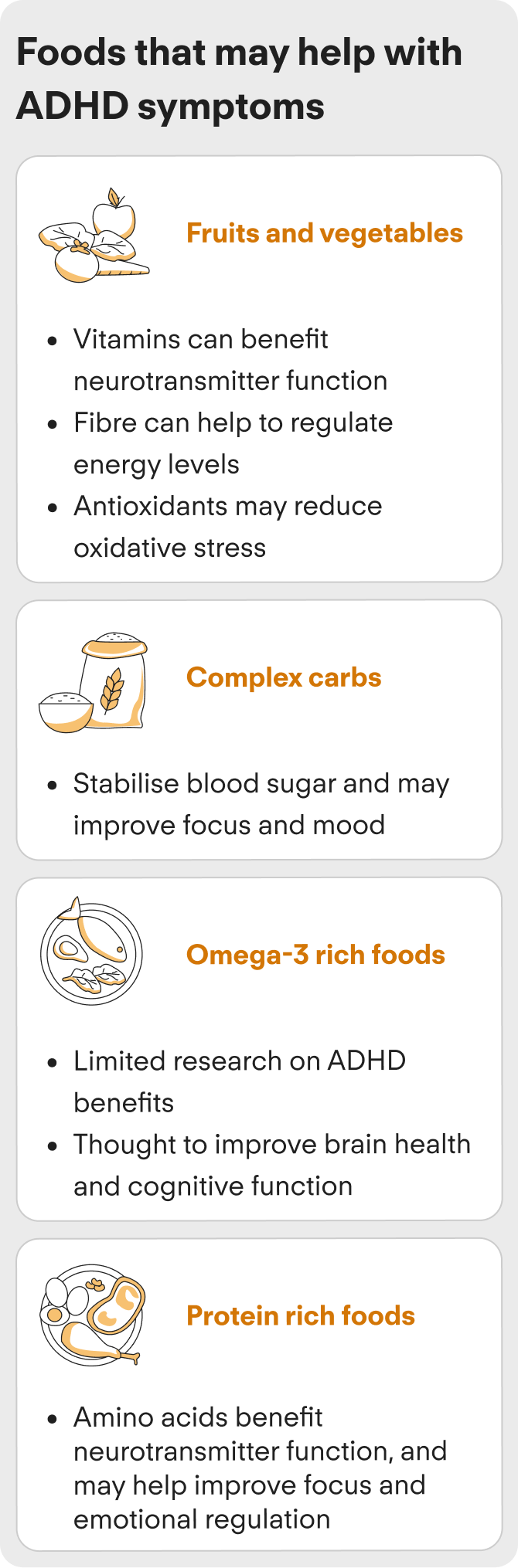
Which foods help with ADHD symptoms?
A balanced, varied diet containing a wide range of nutrients is the best option to help you stay healthy overall.
But some research suggests that certain foods may be particularly beneficial at helping to manage ADHD symptoms.
Fruits and vegetables
Eating plenty of fruit and vegetables can have several benefits for someone with ADHD:
Vitamins and the brain
Fruits and vegetables are typically rich in a varied range of vitamins, which helps to maintain neurotransmitter function in the brain.
Neurotransmitters, like dopamine and norepinephrine, are chemicals that signal different areas in the brain linked to attention, focus, motivation, impulse control, and executive function.
When dopamine and norepinephrine are out of balance, this can lead to a worsening of ADHD symptoms.
The vitamins found in fruit can help to maintain a balance of these hormones.
For example, vitamins B1, B5 and B6 synthesise neurotransmitters that help the brain to function properly,[1] and you’ll find them in fruits like bananas, oranges, mangoes, blueberries and avocado.
Vitamin C (found in oranges, pineapples and kiwifruit) is thought to help with the conversion of dopamine into norepinephrine, and vitamin D (found in figs, grapes and avocado) may help to regulate dopamine activity in the brain.[2]
So a diet rich in these vitamins, which are found in fruits and vegetables, may help someone with ADHD to manage their symptoms.
Blood sugar and energy
Fruits and vegetables are high in fibre, which helps to regulate blood sugar and flatten energy spikes and dips.
Fibre helps to slow down the digestion of food in the gut, which helps the body to take up sugar from foods at a slower, steadier rate.[3]
By stabilising blood sugar levels, this may help to lower the severity of symptoms that come with fluctuating energy levels, such as inattention and hyperactivity.
For example, one study of children with ADHD suggested that fruit and vegetable intake was ‘inversely associated’ with inattention – suggesting that the fewer fruit and vegetables they ate, the more severe their inattention was likely to be.[4]
Antioxidants and stress
Berries and leafy greens are examples of produce that are high in antioxidants. These may have a beneficial effect on reducing oxidative stress, which has been linked to the progression of ADHD.[5]
Oxidative stress is an imbalance of molecules in the body that can lead to premature aging and health issues.[6]
Reactive oxygen species, or ROS, are molecules produced naturally by the body as it metabolises cells. ROS molecules are unstable, and can damage other cells.
They’re usually neutralised by antioxidant molecules to prevent this from happening. But when the body produces more ROS molecules than usual, or if the body’s antioxidant response is weakened, this can lead to higher levels of ROS, causing oxidative stress.
Oxidative stress may worsen ADHD symptoms in several ways, by damaging neurotransmitter pathways in the brain.[7] The effects of this may be loss of attention and focus, lowered impulse control, and reduced executive function.
It’s been suggested that eating a diet that contains certain foods high in antioxidants may help to counteract this.[7] Blueberries[8], strawberries[9] and raspberries[10] are known for their antioxidant properties, as are leafy greens like spinach and kale, and nuts like pecans and walnuts.
Complex carbs
You’ll generally find complex carbohydrates in:
- whole grains (like brown rice, or used in brown bread)
- vegetables (like sweet potatoes and butternut squash)
- and legumes (beans, lentils and peas).
The difference between ‘complex’ and ‘simple’ carbohydrates is that the complex type takes longer to pass through the digestive system, and longer for the body to break down. This means the body won’t take up sugars from this type of food as quickly, helping blood sugar to remain stable, and ensuring more consistent energy release.
This slower, steadier rate of sugar takeup may help to improve attention span, focus, and mood regulation.
Omega-3 rich foods
Study results on the effects of omega-3 supplementation in people with ADHD have been mixed:
One study that involved giving children with ADHD a type of omega-3 supplement called eicosapentaenoic acid (EPA) for 12 weeks found that it improved attention span and focus, but it was quite a small study group (92 people in total).[11]
An older analysis found that levels of omega-3 tend to be lower in children with ADHD, and that supplementation may have some effect on improving symptoms.[12]
But even if the specific benefits of omega-3 on ADHD symptoms haven’t been established, it’s still a good idea to get enough of it in your diet.
Omega-3 is thought to help with brain health and cognitive function[13], which may have indirect benefits for someone with ADHD who struggles with working memory or task paralysis.
You can find omega-3 in supplements, but it’s also rich in foods like:
- oily fish (salmon, mackerel, sardines and fresh tuna); and:
- seeds and nuts (chia, flax or hemp seeds, walnuts).
Protein rich foods
Protein is involved in cell-rebuilding processes throughout the body, including in the brain.[14] Diets sufficient in protein have also been associated with a reduction in cognitive decline and the risk of developing dementia.[15]
But there is also some research to suggest that protein can help to improve cognitive function itself,[16] which may have benefits for someone with ADHD.
Protein provides the brain with amino acids, and aids the production of neurotransmitters like dopamine and norepinephrine (which help with focus and motivation) and serotonin (which helps with emotional regulation).
It’s recommended to eat 0.8 grams of protein per kilogram of bodyweight per day. Foods like:
- lean meat (turkey and chicken)
- fish
- greek yoghurt
- lentils and beans
- tofu, tempeh and seitan
- nuts and seeds
are rich protein sources.
Sources:
[1] Calderón‐Ospina, C.A. and Nava‐Mesa, M.O. (2019). B vitamins in the nervous system: Current knowledge of the biochemical modes of action and synergies of thiamine, pyridoxine, and Cobalamin. CNS Neuroscience & Therapeutics, [online] 26(1), pp.5–13.
[2] Pullar, J.M., Carr, A.C., Bozonet, S.M. and Vissers, M.C.M. (2018). High vitamin C status is associated with elevated mood in male tertiary students. Antioxidants (Basel, Switzerland), [online] 7(7), p.91.
[3] Riccardi, G. and Rivellese, A.A. (1991). Effects of dietary fiber and carbohydrate on glucose and lipoprotein metabolism in diabetic patients. Diabetes care, [online] 14(12), pp.1115–25.
[4] Robinette, L.M., et al (2022). Fruit and vegetable intake is inversely associated with severity of inattention in a pediatric population with ADHD symptoms: The MADDY study. Nutritional Neuroscience, [online] 26(6), pp.1–10.
[5] Wharton, S., et al (2025). Oral Semaglutide at a Dose of 25 mg in Adults with Overweight or Obesity. New England Journal of Medicine, 393(11), pp.1077–1087.
[6] Preiser, J.-C. (2012). Oxidative stress. Journal of Parenteral and Enteral Nutrition, 36(2), pp.147–154.
[7] Verlaet, A.A.J., Maasakkers, C.M., Hermans, N. and Savelkoul, H.F.J. (2018). Rationale for dietary antioxidant treatment of ADHD. Nutrients, [online] 10(4), p.405.
[8] Dróżdż, P., Šėžienė, V. and Pyrzynska, K. (2017). Phytochemical properties and antioxidant activities of extracts from wild blueberries and lingonberries. Plant Foods for Human Nutrition, [online] 72(4), pp.360–364.
[9] Wallace, T.C., Slavin, M. and Frankenfeld, C.L. (2016). Systematic review of anthocyanins and markers of cardiovascular disease. Nutrients, [online] 8(1), p.32.
[10] God, J., Tate, P.L. and Larcom, L.L. (2010). Red raspberries have antioxidant effects that play a minor role in the killing of stomach and colon cancer cells. Nutrition research (New York, N.Y.), [online] 30(11), pp.777–82.
[11] Chang, J.P.-C., et al (2019). High-dose eicosapentaenoic acid (EPa) improves attention and vigilance in children and adolescents with attention deficit hyperactivity disorder (ADHD) and low endogenous EPa levels. Translational Psychiatry, [online] 9(1).
[12] Hawkey, E. and Nigg, J.T. (2014). Omega−3 fatty acid and ADHD: Blood level analysis and meta-analytic extension of supplementation trials. Clinical Psychology Review, 34(6), pp.496–505.
[13] DiNicolantonio, J.J. and O’Keefe, J.H. (2020). The importance of marine Omega-3s for brain development and the prevention and treatment of behavior, mood, and other brain disorders. Nutrients, [online] 12(8), p.2333.
[14] Research, I.M.U.C.M.N. (1999). Amino acid and protein requirements: Cognitive performance, stress, and brain function. [online] National Academies Press (US).
[15] Godman, H. (2022). Protein intake associated with less cognitive decline. [online] Harvard Health.
[16] Adams, M.S., Mensink, R.P. and Joris, P.J. (2024). Effects of dietary proteins on cognitive performance and brain vascular function in adults: A systematic review of randomised controlled trials. Nutrition Research Reviews, [online] pp.1–15.
Reading time: 8 min
Uploaded on: September 16, 2026
Medically reviewed by Daniel Atkinson GP Clinical Lead Registered with GMC (4624794) September 16, 2026 Meet Daniel Atkinson