

Medically reviewed by Daniel Atkinson GP Clinical Lead
Reading time: 7 min
Uploaded on: September 16, 2026
Diet can affect ADHD in a few different ways:
- Certain foods can make ADHD symptoms worse.
- Some eating habits can have a negative impact on symptoms too.
- But there are some types of food that might help with symptoms.
There’s no evidence to suggest that diet causes or increases the risk of ADHD.
Can certain foods make ADHD symptoms worse?
Everyone is different, but certain foods can be more likely to worsen ADHD symptoms.
Sugary foods
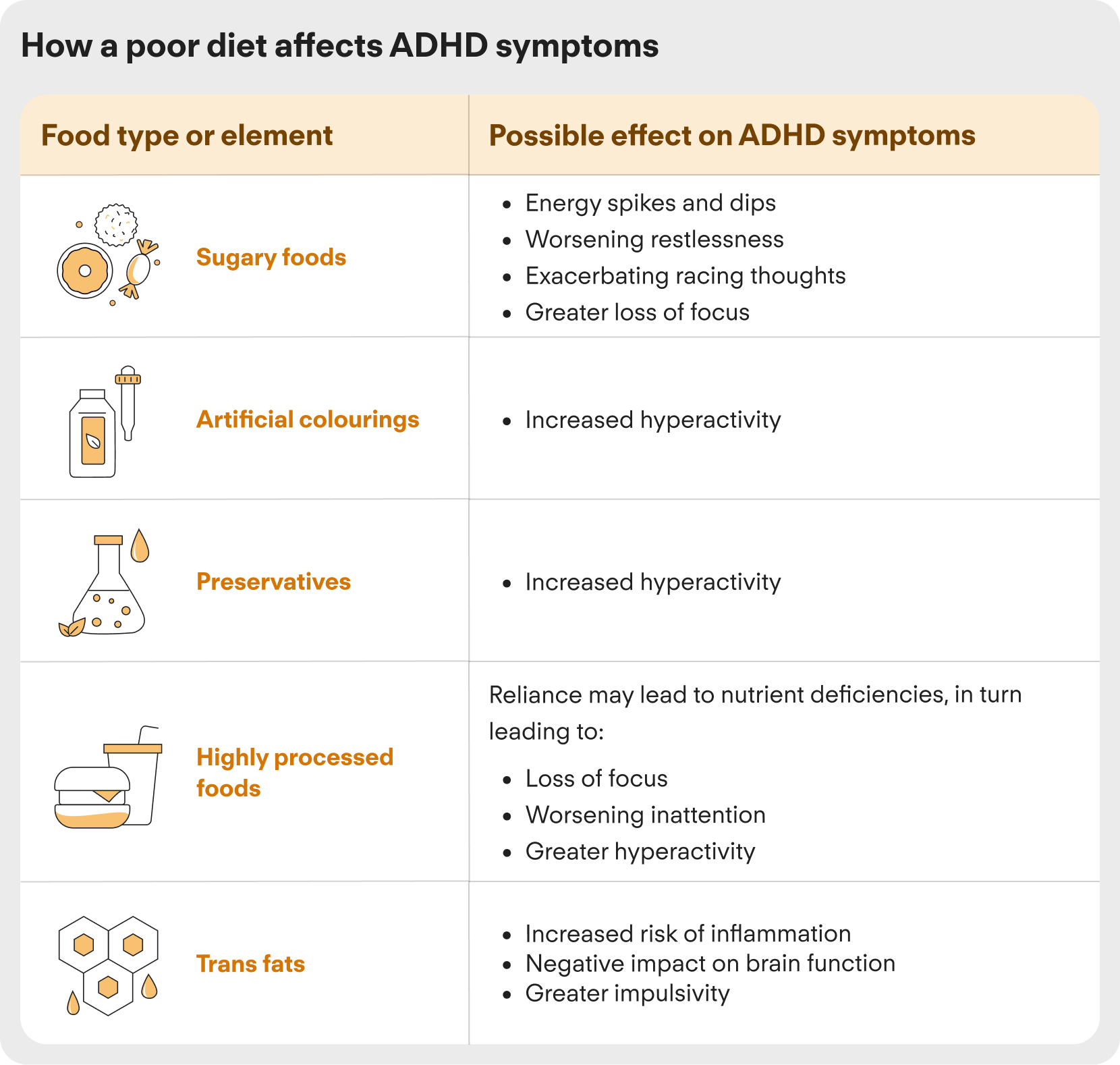
Foods high in sugar can cause energy spikes and dips. So for people with ADHD, it’s likely that eating foods particularly high in sugar may lead to worsening symptoms.
By causing energy to sharply increase, sugary foods can worsen fidgeting and inattentiveness, or racing thoughts.
For example, there is some research to suggest that diets high in sugar can increase inattention in people with ADHD.[1] It’s also been suggested by another study that excessive sugar consumption can make children with hyperactivity more restless and destructive.[2]
Energy crashes, which come after the ‘high’ you get when eating sugary food, can make it harder to focus too. Research has found a link between high sugar consumption and reduced cognitive function.[3] So after a period of high energy (and hyperactivity), the low that comes afterwards can also impact someone’s ability to concentrate.
Additives
Man-made substances that are added to food are called ‘additives’. They might be added to food to:
- strengthen the taste (flavour enhancers)
- change the appearance or colour (colourings)
- help it last longer (preservatives)
Foods containing additives will be processed. They’re generally less healthy than ‘whole foods’ which are made only from natural ingredients.
But additives themselves can affect ADHD symptoms too.
Artificial colourings and dyes
Artificial food colourings and dyes have been linked with increased hyperactivity in children both with and without ADHD.[4]
A study funded by the Food Standards Agency found that certain colours caused higher levels of hyperactivity when consumed by some children.[5]
Foods such as:
- sweets
- crisps
- fizzy drinks
- brightly coloured breakfast cereals
- table sauces and condiments
commonly contain food colourings.
Preservatives
Some research also suggests that the preservative sodium benzoate, when combined with colourings, may increase hyperactivity too.[6]
Sodium benzoate is found in some fruits in very small amounts. But as a preservative, it’s commonly added to:
- fizzy drinks
- juices
- condiments, like mayonnaise
- margarine
- salad dressings
- pickles
The effects of additives on ADHD symptoms is an area still being researched.
Some studies have looked into the benefits of ‘elimination diets’ for people with ADHD, which involves avoiding foods containing artificial colourings, flavourings and certain preservatives. But the overall success rate of these at improving ADHD symptoms isn’t clear, and some people have been shown to benefit from them more than others.[7]
Highly processed foods
Basically, a processed food is any food that’s gone through a process before you buy it.
This might be washing, cutting, adding ingredients, freezing, cooking, or something else.
There are different levels of processed food:
Minimally processed. Frozen vegetables are an example, because they might just be washed, frozen, then packaged for sale.
Processed. This type might have oil, butter, sugar, or salt added to it. ‘Processed’ foods generally contain two or three ingredients in total. Examples include bread, cheese, tinned fruit or jarred vegetables.
Highly processed. Also called ‘ultra-processed food’ or UPF. This type is usually mass-produced and contains additives or extracts from several other types of food. Microwave meals, savoury snacks and sweets are examples.
Most people eat some type of processed food. In moderation, it can be part of a healthy diet.
When you hear ‘processed food’ in relation to diet, it’s generally used to mean ‘highly processed food’.
A diet containing a lot of highly processed foods might make ADHD symptoms worse for a few reasons.
Lack of nutrients
Certain vitamins and minerals, like magnesium, vitamin B and D, and omega-3, have been shown to support brain function.[8][9][10]Ultraprocessed foods can often lack these vitamins and minerals.
The more ultraprocessed foods someone has in their diet, the less room there is for other, healthier foods containing these essential nutrients. This might lead to nutrient deficiencies that negatively affect brain function, making lack of focus, inattention and impulsivity worse for someone with ADHD.
Saturated and trans fat
Highly processed foods can also have a high saturated or trans fat content.
For example, processed meats, like sausages, hot dogs, bacon or luncheon meats tend to be high in saturated fat.
Deep-fried foods, pies, cakes, donuts and biscuits can also be high in saturated fat, and may sometimes contain trans fats.
Research has found that processed meat and snack consumption is higher in children with ADHD, and that there’s a correlation between consumption and ADHD symptoms.[11]
One way that foods high in saturated or trans fats may make ADHD symptoms worse is through inflammation.
Saturated and trans fat can contribute to inflammation in the body, in a few different ways.[12][13][14] Some research has shown inflammation can negatively impact brain function,[15] and that it may be factor in ADHD symptoms.[16]
By stopping signalling in the brain from working properly, inflammation might make symptoms like inattention, lack of focus, and impulsivity worse.
Sources
[1] Jones, Timothy W., et al. (1995). “Enhanced Adrenomedullary Response and Increased Susceptibility to Neuroglycopenia: Mechanisms Underlying the Adverse Effects of Sugar Ingestion in Healthy Children.” The Journal of Pediatrics, vol. 126, no. 2, Feb. 1995, pp. 171–177.
[2] Prinz, Robert, et al. (1980). “Dietary Correlates of Hyperactive Behavior in Children.” Journal of Consulting and Clinical Psychology, vol. 48, no. 6, 1980, pp. 760–769.
[3] Gillespie, Kerri M., et al. (2023). “The Impact of Free and Added Sugars on Cognitive Function: A Systematic Review and Meta-Analysis.” Nutrients, vol. 16, no. 1, 25 Dec. 2023, p. 75.
[4] Arnold, L. Eugene, et al. (2012). “Artificial Food Colors and Attention-Deficit/Hyperactivity Symptoms: Conclusions to Dye For.” Neurotherapeutics, vol. 9, no. 3, July 2012, pp. 599–609.
[5] Food Standards Agency. “Food Additives.” Food Standards Agency, 14 Oct. 2019.
[6] McCann, Donna, et al. (2007). “Food Additives and Hyperactive Behaviour in 3-Year-Old and 8/9-Year-Old Children in the Community: A Randomised, Double-Blinded, Placebo-Controlled Trial.” The Lancet, vol. 370, no. 9598, Nov. 2007, pp. 1560–1567.
[7] Nigg, Joel T., and Kathleen Holton. (2014). “Restriction and Elimination Diets in ADHD Treatment.” Child and Adolescent Psychiatric Clinics of North America, vol. 23, no. 4, Oct. 2014, pp. 937–953.
[8] Peeri, Noah C., et al. (2020). “Association of Magnesium Intake and Vitamin D Status with Cognitive Function in Older Adults: An Analysis of US National Health and Nutrition Examination Survey (NHANES) 2011 to 2014.” European Journal of Nutrition, 9 May 2020.
[9] Stonehouse, Welma, et al. (2013). “DHA Supplementation Improved Both Memory and Reaction Time in Healthy Young Adults: A Randomized Controlled Trial.” The American Journal of Clinical Nutrition, vol. 97, no. 5, 1 May 2013, pp. 1134–1143,
[10] Castle, Monica, et al. (2019). “Three Doses of Vitamin D and Cognitive Outcomes in Older Women: A Double-Blind Randomized Controlled Trial.” The Journals of Gerontology: Series A, vol. 75, no. 5, 14 Feb. 2019, pp. 835–842.
[11] Akin, Sumeyye. (2021). “Processed Meat Products and Snacks Consumption in ADHD: A Case-Control Study.” Northern Clinics of Istanbul, vol. 9, no. 3, 2021.
[12] Oteng, Antwi-Boasiako, & Sander Kersten. (2019). “Mechanisms of Action of Trans Fatty Acids.” Advances in Nutrition, vol. 11, no. 3, 29 Nov. 2019.
[13] Milanski, M., et al. (2009). “Saturated Fatty Acids Produce an Inflammatory Response Predominantly through the Activation of TLR4 Signaling in Hypothalamus: Implications for the Pathogenesis of Obesity.” Journal of Neuroscience, vol. 29, no. 2, 14 Jan. 2009, pp. 359–370.
[14] Nicholls, Stephen J., et al. (2006). “Consumption of Saturated Fat Impairs the Anti-Inflammatory Properties of High-Density Lipoproteins and Endothelial Function.” Journal of the American College of Cardiology, vol. 48, no. 4, Aug. 2006, pp. 715–720.
[15] Lewis, Naomi, et al. (2025). “Gut Dysbiosis as a Driver of Neuroinflammation in Attention-Deficit/Hyperactivity Disorder: A Review of Current Evidence.” Neuroscience, vol. 569, 21 Jan. 2025, pp. 298–321.
[16] Anand, Deepa, et al. (2017). “Attention-Deficit/Hyperactivity Disorder and Inflammation: What Does Current Knowledge Tell Us? A Systematic Review.” Frontiers in Psychiatry, vol. 8, 9 Nov. 2017,
Reading time: 7 min
Uploaded on: September 16, 2026
Medically reviewed by Daniel Atkinson GP Clinical Lead Registered with GMC (4624794) September 16, 2026 Meet Daniel Atkinson