

Medically reviewed by Daniel Atkinson GP Clinical Lead
Reading time: 8 min
Uploaded on: September 16, 2026
ADHD can affect our relationship with food in different ways.
Certain ADHD symptoms can change:
- your eating habits
- the way you feel about food
- the way you react to food
ADHD medications can have an effect on how you eat too.
ADHD symptoms and diet
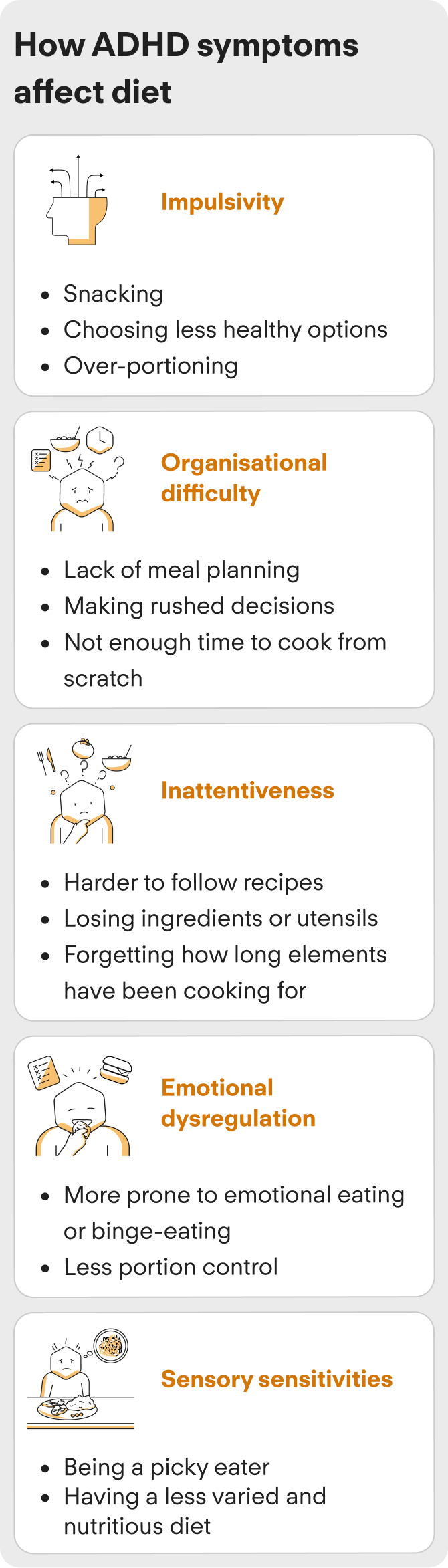
If you have ADHD, you might find your eating habits affected by:
- Impulsivity
- Difficulty planning
- Inattentiveness
- Emotional dysregulation
- Sensory sensitivities
Examples include:
Impulsivity
Impulsivity is a common symptom of ADHD. It’s where someone acts or makes a decision before thinking it through.
Example: Someone having a momentary craving for food, then grabbing a snack and eating it before they’ve thought about how hungry they are.
A study into the eating habits of young adults with ADHD found that those with a higher impulsivity symptom score ate snacks more frequently.[1]
So impulsivity might influence your decision over whether to eat something, but it can also affect food choices.
Imagine you’re at a food counter, choosing between a bowl of fruit and a piece of cake. Impulsivity might cause you to choose the less healthy food option (the cake), before taking time to think about what would be the healthier option (the fruit).
Impulsivity can make portion control more difficult too. Your body sends out ‘fullness cues’ when you’re eating, to tell you that you’ve had enough. Impulsivity can make it harder to notice these, so you might be more likely to carry on eating after you’re full.
Difficulty planning
People with ADHD can struggle with planning and organisation. This can have a big effect on food choices, because eating healthily usually means planning meals in advance.
Example: Preparing a healthy meal for each evening of the week often means:
- buying ingredients you need beforehand; and
- putting aside the time you need to prepare your meals.
If you find planning difficult, it’s more likely that you’ll have to make rushed decisions about what to eat, and choose whatever you can prepare easily and quickly. This might mean eating more processed foods or microwave meals.
Inattentiveness
Inattention, a common symptom of ADHD, can make it harder to:
- do certain tasks without making mistakes
- follow instructions
- manage your time
- keep track of where things are
All of this might make meal preparation more difficult.
Example: People with ADHD may find it harder to follow recipes, remember how long elements have been cooking for, or keep track of where utensils or ingredients are.
And if meal preparation seems more difficult, then it may be more tempting to choose a simpler option, like a microwave or processed meal.
Emotional dysregulation
People with ADHD can find coping with feelings of stress and anxiety more challenging.
To help them deal with these emotions, a person with ADHD might be more prone to emotional eating.
Examples of emotional eating might be:
- eating very sugar-dense foods
- binge-eating or snacking
- having larger portion sizes than usual
A common reason for emotional eating is that certain types of foods – like those high in fat or simple carbohydrates like sugar – can create a short-term mood boost by triggering chemicals in the brain, like dopamine. So someone who feels anxious or stressed might use emotional eating to try and make themselves feel better.
But after the short-term boost has gone, these types of foods often have a worsening effect on ADHD symptoms like impulsivity and inattention.[2]
Sensory sensitivities
There is research to suggest that both children[3] and adults[4] with ADHD are more likely to be ‘picky eaters’.
And in part, this may be because it’s common for people with ADHD to have sensory sensitivities.
This is when someone comes across a ‘stimuli’ they’re sensitive to, and their brain has difficulty processing it. This can make them feel:
- stressed
- irritable
- unable to concentrate
For some people with ADHD, these feelings of ‘overload’ might happen when they taste or smell certain foods, or have a certain texture of food in their mouth.
This can make stronger-smelling or tasting foods (like fish) much less appealing.
Whole foods like vegetables tend to have very unique textures too, which someone with a sensory sensitivity might not be able to tolerate as well.
This can mean that someone with sensory sensitivities ends up with less variety in their diet, and getting fewer nutrients overall.
ADHD medication
The relationship between ADHD medications and diet is complicated.
On one hand, stimulants can lower your appetite while you’re using them, so you don’t eat as much. One study of a widely-prescribed stimulant used in ADHD found that it lowered calorie intake in people taking it by 11%.[5] Another study found that it resulted in an average weight loss of 2.03kg in people taking it, compared to placebo.[6]
For some people, this might mean that their appetite drastically increases if they eventually stop their medication.
On the other hand, some research suggests that children who took stimulant medication from an early age had a slower BMI growth compared to those who didn’t take this medication, but then ‘rebounded’ to a higher BMI level in their later teens.[7]
So how ADHD medication affects your weight can depend on:
- your individual response to the drug
- how long you’ve been taking it
- and when you originally started taking it.
Sources:
[1] Dalnoki, Laura, et al. (2024). “Exploring the Relationship of Dietary Intake with Inattention, Hyperactivity, and Impulsivity, beyond ADHD.” Journal of Attention Disorders, 5 Nov. 2024.
[2] Arshad, M.T., et al (2025). Role of dietary carbohydrates in cognitive function: A review. Food Science & Nutrition, 13(7).
[3] Kaşak, M., et al (2025). Selective eating and sensory sensitivity in children with <scp>ADHD</scp>: A comparative study of ARFID symptom profiles. International Journal of Eating Disorders.
[4] Bayoumi, S.C., Halkett, A., Miller, M. and Hinshaw, S.P. (2025). Food selectivity and eating difficulties in adults with autism and/or ADHD. Autism, 29(6), pp.1497–1509.
[5] Goldfield, Gary S, et al. (2007). “Methylphenidate Reduces Energy Intake and Dietary Fat Intake in Adults: A Mechanism of Reduced Reinforcing Value of Food?” The American Journal of Clinical Nutrition, vol. 86, no. 2, 1 Aug. 2007, pp. 308–315, https://doi.org/10.1093/ajcn/86.2.308. Accessed 31 Oct. 2021.
[6] Fernand Vedrenne-Gutiérrez, et al. (2024). “Methylphenidate Can Help Reduce Weight, Appetite, and Food Intake—a Narrative Review of Adults’ Anthropometric Changes and Feeding Behaviors.” Frontiers in Nutrition, vol. 11, 29 Nov. 2024, https://doi.org/10.3389/fnut.2024.1497772.
[7] Schwartz, Brian S., et al. (2014). “Attention Deficit Disorder, Stimulant Use, and Childhood Body Mass Index Trajectory.” Pediatrics, vol. 133, no. 4, 1 Apr. 2014, pp. 668–676, https://doi.org/10.1542/peds.2013-3427. Accessed 7 Apr. 2022.
Reading time: 8 min
Uploaded on: September 16, 2026
Medically reviewed by Daniel Atkinson GP Clinical Lead Registered with GMC (4624794) September 16, 2026 Meet Daniel Atkinson