


Reading time: 6 min
Uploaded on: January 12, 2026
Dating and relationships aren’t always easy. Add ADHD into the mix, and certain situations within romantic relationships can often become even more complex.
There are lots of reasons why ADHD might cause frustration between couples. Symptoms like inattention, emotional dysregulation, difficulty staying organised and struggling with motivation can all take their toll and cause tension.
In an effort to understand the scale of these effects more, Focused carried out a survey asking people living with the condition about their experiences.
The key findings were that:
- 68% had either waited at least a year to tell their partner that they have ADHD, or hadn’t told them at all
- 70% had had a break-up that was due, or partly due, to ADHD
- 87% had experienced tension in relationships caused by ADHD
- 65.5% said that ADHD had stopped them from asking someone on a date
The survey was opened in November 2025 and collected responses over four weeks, and was open to anyone living with ADHD over the age of 18. The survey was promoted in partnership with Alex Partridge and the ADHD Chatter Podcast. 400 people responded.
Let’s look at some of the findings in more detail:
When do people share their ADHD diagnosis with partners?
We asked respondents:
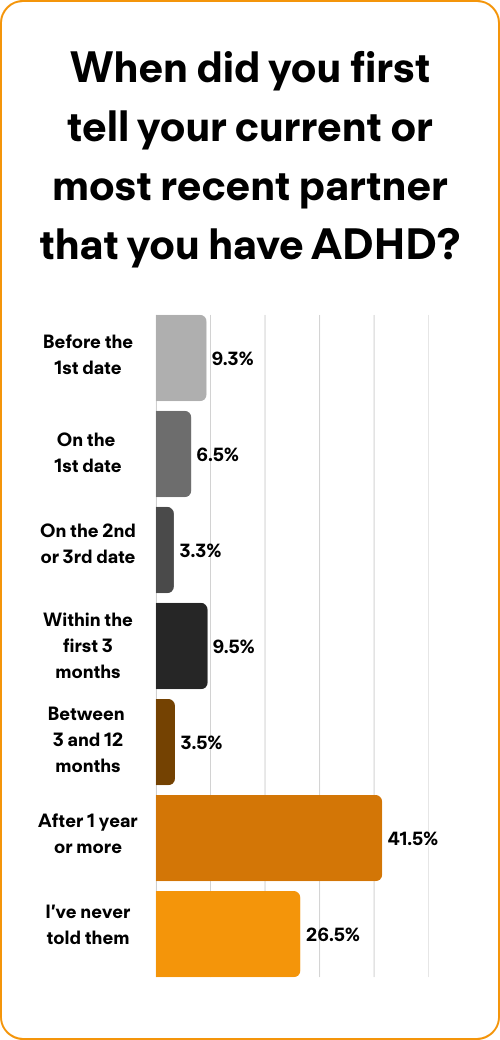
The results revealed some polarising approaches to transparency regarding diagnosis.
Over two thirds of respondents (68%) either waited a year or more to tell their partner about their ADHD diagnosis, or didn’t tell them at all.
This seems to indicate that many people with ADHD mask the condition from new partners, possibly due to stigma surrounding the condition, and anxiety about how they'll be perceived.
As we know, ADHD is a commonly misunderstood condition. Someone with ADHD might have concerns that if they share their diagnosis with a new partner, they’ll be seen as:
- lazy
- a poor listener
- disorganised
- hyperactive
- prone to impulsive or poor decision making
- or emotionally high maintenance.
That said, awareness around ADHD is improving, and people are becoming more understanding of the condition.
And it’s important to note that many respondents who took the survey will have been signposted through the ADHD Chatter Podcast – of which, a significant portion of the audience is aged over 35.
So with these factors in mind, this result could point more towards a historical stigma that’s existed around ADHD, and the desire – be it conscious or subconscious – to appear neurotypical to a prospective love interest. Many people who completed the survey may have been in relationships for several years, and back when they started dating their partner, ADHD may have been more of a taboo subject.
This could partially explain this more ‘old-fashioned approach’ to revealing a diagnosis.
The slightly higher numbers at the other end of the scale, who said ‘Before the 1st date’ or ‘On the 1st date’ could be indicative of the ‘Tinder’ generation of daters (predominantly Millennials and younger):
- getting to know prospective partners online before meeting in person,
- feeling less restricted by stigma surrounding ADHD,
- and being more open and upfront about their diagnosis.
Focused Clinical Lead, Danielle Mulligan, commented:
‘There are likely generational factors at play here. Given that many of the people who responded to the survey would probably have been aged over 35, my feeling is that this result can be partially attributed to the historical stigma that ADHD has had – a lot of people completing this survey may have started their relationships several years ago, when ADHD wasn’t as well-known or understood.
ADHD awareness is growing thankfully, and I’m optimistic that more people are starting to understand what the condition can be like, so it’s an easier one to open up about. We’re seeing flickerings of this in these results, with some people opening up about their diagnosis before or on the first date.
What would be really interesting is to ask this question again in 10 years' time, to see how attitudes have changed.’
How many people have broken up over ADHD?
We asked respondents:
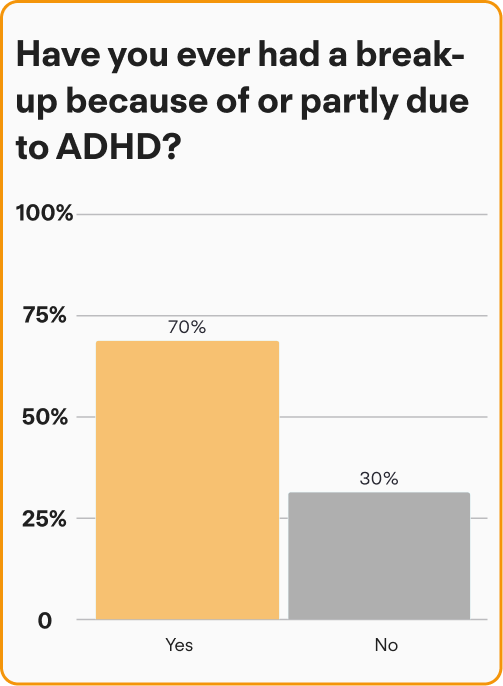
and:
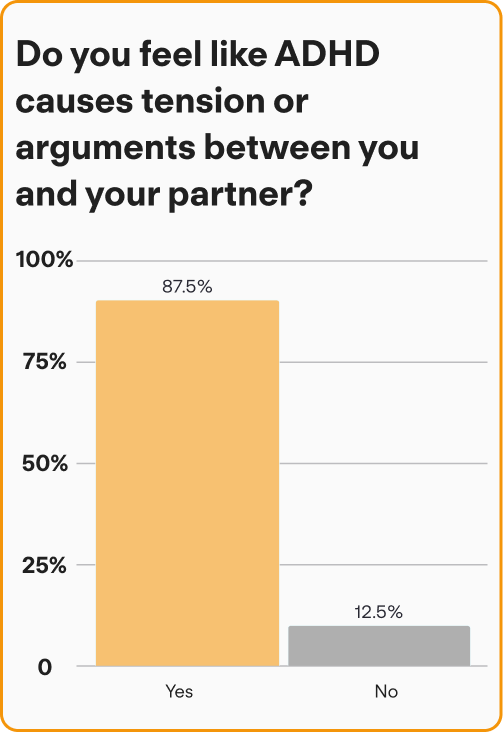
While the results paint a pessimistic picture, it’s one that’s likely unsurprising for many with ADHD.
Inattention can lead to communication problems in relationships, with partners of people with ADHD potentially feeling like they’re disinterested or disengaged.
Problems with executive function and forgetfulness may mean someone with ADHD doesn’t always fulfil their ‘load’ in the relationship (for example carrying out chores or organising activities).
Impulsivity and emotional dysregulation are other ADHD symptoms that can contribute towards the escalation of disagreements between partners, so that they become more heated.
But interestingly, the percentage of people who reported tension or arguments in their relationship was higher among those who said they’d never told their partner about their ADHD diagnosis (94.3%). This suggests that failing to communicate about an ADHD diagnosis could be more likely to lead to relationship problems later on.
On a more positive note, the segment of respondents who’d never told their partners about their ADHD diagnosis didn’t have a higher percentage of break-ups caused by ADHD (70.8% vs 70%).
Danielle Mulligan noted that:
‘It’s sad – but to be expected – that we would see ADHD playing a role in tension in relationships, and even more sad to see that people feel like it’s been responsible or partially responsible for a break-up.
That said, it’s slightly encouraging that the percentage of people who said that it had been responsible for a break-up was lower than the percentage of people who’d said it caused tension, by about 17%. So this could indicate that there’s a point of understanding many partners reach, where empathy for the effects of ADHD kicks in and the problems don’t escalate further into a break-up.
And there is probably an element of self-conscious bias we need to take into account here, where people living with ADHD blame the condition for being the root cause, even though it may not necessarily have been.
But 70% is still a lot, and it’s not a nice statistic. Again, even as awareness and understanding of ADHD grows, the symptoms associated with it are probably always going to contribute to some level of tension – but as this understanding increases, we should in theory start to see the percentage of people saying it’s caused a break-up fall in the future.
It can be difficult to open up about an ADHD diagnosis to a new partner, but the results here seem to suggest that opening up may help to offset tension later on in the relationship for some people.’
Does ADHD stop people asking someone on a date?
We asked respondents:
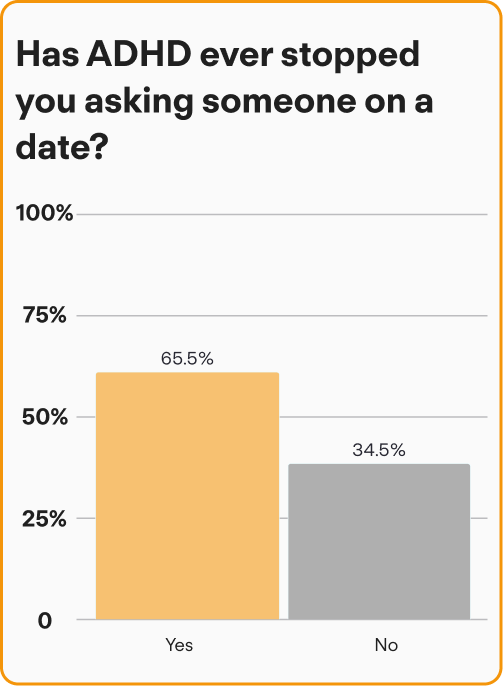
The result here shows how rejection sensitive dysphoria, a common symptom of ADHD, can be a significant factor for people deciding whether to approach someone about a date.
RSD is when rejection causes intense feelings of emotional pain, and it can often be exacerbated by emotional dysregulation (another symptom of ADHD).
This can lead to people with ADHD avoiding situations where they might be rejected, and might show in social scenarios as withdrawal or low self-esteem.
But overthinking (also an ADHD symptom) could be a factor here too, as Danielle explains:
‘We’re likely seeing the shadow cast by RSD here in a big way. People with ADHD might be less likely to take that big step and ask someone out because of the fear of emotionally-crippling rejection. But there are other reasons too that could be at play here.
Overthinking is something people with ADHD are prone to doing, and this could create non-existent problems in a relationship before it’s even begun (‘What about if XYZ happens?’ ‘What if we start going out but they break up with me because of XYZ?’).
Executive function challenges can be a reason for not asking someone out too – the prospect of arranging and organising a date might just feel overwhelming, and discourage someone from making that approach.’
Do people with ADHD tend to get together with others who have ADHD?
Another question we asked was:
.png)
This result might seem unexpected, but there are reasons why someone with ADHD may be both more or less likely to gravitate towards someone else with ADHD.
People with ADHD may be drawn to others with the condition because:
- they’ll have shared experience of the condition
- they’re more likely to feel understood
- they may have a similar communication style
- a shared sense of impulsivity can often lead to a more ‘fun’ and spontaneous dynamic.
On the other hand, someone with ADHD may be less likely to gravitate to someone else with ADHD because:
- they want to avoid the amplification of their own symptoms
- they recognise that someone who doesn’t have ADHD may be better at supporting them or complementing their characteristics in a relationship.
And obviously in many cases, a prospective partner’s ADHD ‘status’ may not be a factor at all.
Danielle noted that:
‘It’s quite common for people living with ADHD to seek partners who have had a shared experience, or who they feel might understand them more. There’s the fun, impulsive, spontaneous element too that a partner who also lives with ADHD can bring to a relationship.
But that said, for many people – as we see with this result – it may not be that much of a factor, or they may actively seek someone who doesn’t have an ADHD diagnosis, possibly to avoid ‘amplification’ of their own symptoms and the potential issues this could bring.’
Navigating relationship issues with ADHD
While ADHD can sometimes make relationships more complex, if you or your partner has ADHD, there are steps you can take that might help things go a little more smoothly.
Being open about your diagnosis
It’s up to you when to tell a new partner about an ADHD diagnosis, and sharing this information with someone is privileged info you might (rightly) feel needs to be earned over time, once you’ve developed trust and confidence in each other.
But it’s worth keeping in mind that symptoms and behaviours related to ADHD can sometimes cause tension in relationships – and without the context of an ADHD diagnosis behind them, issues and disagreements can arise.
So sharing this info – especially before you reach a stage where you commit more to each other in a more meaningful way – can help to offset these issues.
Learning more about the condition
If you have ADHD, being knowledgeable about the condition can help you to anticipate your own behaviours in certain scenarios, so you can avoid tense escalations and diffuse tension.
The same applies if you don’t have ADHD but your partner does – having a greater awareness of the condition helps you to know what to expect, foresee potential issues before they begin, and be more supportive of your partner if they’re experiencing difficulties rooted in ADHD.
Getting help
Seeking support if you have (or think you might have) ADHD can help you to deal with the symptoms associated with it in a more effective way – whether it’s through therapies such as CBT, or just having a confirmed diagnosis if you haven’t had one already.
Coming to terms with your diagnosis and learning how to manage symptoms can have a positive effect on your relationship with your partner too.
Even in cases where the two of you might have some awareness of ADHD and the effects it can have, it can still be difficult to contextualise disagreements as being a partial consequence of ADHD in the heat of the moment.
If you feel like ADHD is causing tension in your relationship, taking steps to manage the condition can have the added benefit of demonstrating to your partner that you’re taking self-care seriously, and making an effort to improve things between you.
Reading time: 6 min
Uploaded on: January 12, 2026

