

Reading time: 4 min
Uploaded on: January 28, 2026
Many women describe feeling like they’ve “lost control” of their ADHD symptoms around menopause, even when they’ve lived with ADHD all their lives.
A large survey of 1,500 women with ADHD found that 94% reported worse symptoms during perimenopause and menopause, identifying memory issues, distractibility, and emotional overwhelm as especially life‑altering in their 40s and 50s.[1]
- ADHD can affect women differently from men, with the inattentive type being more often diagnosed in women. It manifests through symptoms like forgetfulness, zoning out, difficulty focusing, misplacing things, and struggling with planning, which can be easily missed or misdiagnosed.
- Hormone fluctuations, especially falling oestrogen around menopause, can reduce dopamine and serotonin, making ADHD symptoms worse.
- Menopause can amplify existing ADHD struggles: cognitive (brain fog, forgetfulness), emotional (mood swings, irritability), and physical/sensory (fatigue, sleep issues, noise or light sensitivity).
- Managing your ADHD symptoms during the menopausal transition may require higher doses or switching to a different type of medication.
- It’s generally safe to use HRT alongside ADHD medication, and many times they can complement each other.
- Lifestyle changes and self-compassion can also have a huge impact on how you navigate this transition.
How does ADHD affect women?
ADHD can affect women differently from men. The inattentive type tends to be more prevalent in women, meaning they’re more prone to show symptoms associated with poor attention, like:
- forgetfulness,
- difficulty sustaining focus on tasks,
- appearing “spaced out”, not paying attention when other people are talking to them,
- frequently misplacing things,
- missing appointments,
- struggling with task management and planning.
Because these symptoms are less obvious to the outside world, they’re easier for others, including doctors, to miss. This means that many women “slip through the net”, remaining undiagnosed until certain events or stressors, like perimenopause or menopause, cause their symptoms to worsen.[2]
How do hormones affect ADHD?
For women, sex hormones, including oestrogen and progesterone, are known to fluctuate throughout different life phases. The menopause transition is typically associated with decreasing levels of hormones like oestrogen and progesterone, stabilising to very low levels post-menopause.
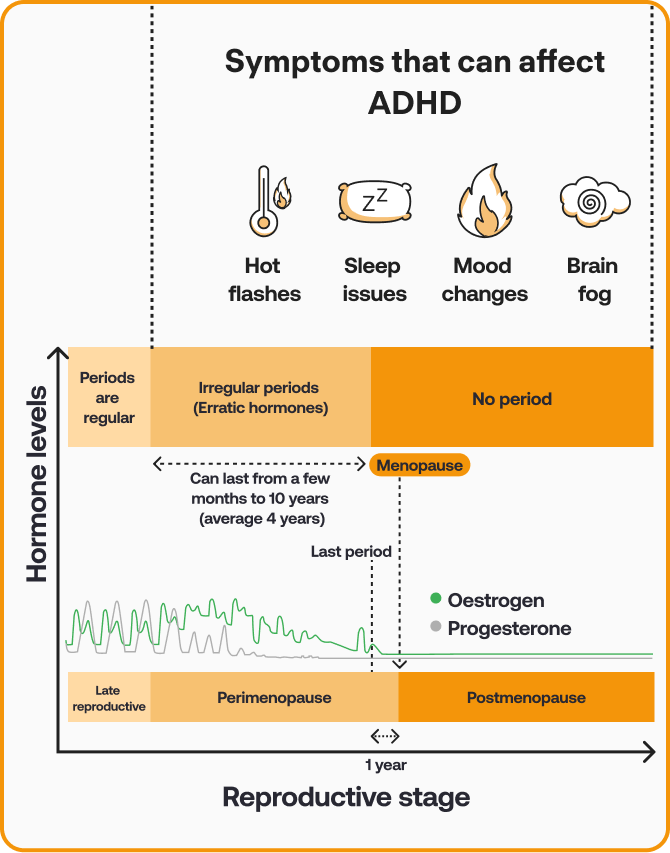
When you have higher levels of oestrogen in your body, like during parts of the menstrual cycle or pregnancy, some women report feeling more focused, calm, and “in control” of their emotions.
But when oestrogen levels fall, like during perimenopause and menopause, this can trigger a drop in dopamine activity. That’s because oestrogen helps stimulate the production of brain chemicals like serotonin, norepinephrine, and dopamine.[3]
But if you have ADHD, your brain is usually already running low on dopamine.[4] So when you enter perimenopause, that deficit deepens, often making previous coping mechanisms or medication dosages less effective.
These effects are further amplified by falling levels of another hormone, progesterone, which has a calming effect on the brain. That’s because it helps activate GABA, the system that quiets neural noise and keeps your emotions steady.[5]
For women with ADHD, whose brains already have a harder time regulating dopamine and serotonin, this can mean feeling more emotionally reactive, stressed, or mentally scattered.
In short: The hormonal shifts that happen during menopause exacerbate ADHD symptoms.
Can menopause change ADHD symptoms?
For many women, the changes in hormone levels and brain chemistry that happen during menopause don’t necessarily introduce entirely new problems. Instead, they amplify existing ones, impacting areas already affected by ADHD, like:
- Cognitive and executive function - women often describe that the following ADHD symptoms worsen during menopause:
- forgetfulness
- difficulty concentrating
- struggling to start or finish tasks
- feeling mentally “foggy” or slower than before
- Emotional regulation - because of changes in brain serotonin and dopamine levels, which play a role in mood stability, many women report experiencing:
- stronger emotional reactions
- increased irritability or frustration
- mood swings that feel harder to control
- reduced tolerance to stress
- Physical and sensory changes - which may include:
- increased noise, light, or touch sensitivity
- sleep issues (further worsening symptoms related to executive function and emotional regulation)
- fatigue (which can worsen symptoms as well).
Bottom line
Menopause doesn’t cause ADHD (even if the ADHD was only diagnosed after menopause), but it can worsen the symptoms that were already present. This can mean that your ADHD may become more noticeable or disruptive in your daily life, and harder to cope with by using the same strategies that worked for you before.
Curious how to handle it? Jump to our guide on How to manage ADHD and menopause.
References:
- ADDitude (2024). How Menopause Affects ADHD Symptoms: Results of Our Survey.
- Attoe, D.E. and Climie, E.A. (2023). Miss. Diagnosis: A Systematic Review of ADHD in Adult Women. Journal of Attention Disorders, 27(7), pp.645–657.
- Osianlis, E., et al. (2025). ADHD in females: Survey findings on symptoms across hormonal life stages. Journal of Psychiatric Research, 193, pp.208–215.
- Madhusoodanan, J. (2026). Untangling the connection between dopamine and ADHD. Nature.
- Girdler, S.S., et al. (2001). Allopregnanolone levels and reactivity to mental stress in premenstrual dysphoric disorder. Biological Psychiatry, 49(9), pp.788–797.
Reading time: 4 min
Uploaded on: January 28, 2026